Help participants work their core with a miniroutine that approaches muscles from different angles while elevating heart rates. Mix 30-second cardio intervals with athletic, integrated core exercises that load the upper body and lower body simultaneously. Here’s how you do it: Teach continuous movement as you alternate between 30 seconds of “cardio-core” and 2 minutes of recovery-pace core work (which includes the transition time from one move to the next). Use dumbbells for added load in every plane of motion as you bend, stand, reach, rotate, catch and brace.
A Sample Menu
Following are some teaching suggestions with examples of both elements: Cardio: Demonstrate the exercise, and cue students to do as many reps as they can safely do in 30 seconds. Encourage them to go breathless. All moves include dumbbells but can be done without them if necessary.
forward jump with snatch
lateral hop lunge with overhead arch
standing broad jump with chest press
lateral jump to vertical jump
sumo jump-squat with snatch
split-lunge hold while holding dumbbells overhead
power skater with reach
tuck jump with 180-degree hop
Recovery-pace core work: Self-select reps, and cycle through for 2 minutes:
lateral walking plank with superman reach
static crab with alternating elbow and knee pulls, then reverse plank
Research has shown that exercise can help reduce arthritis pain and improve range of motion, and it’s now considered an essential part of arthritis management.
This is a far cry from days past, when people with arthritis were warned to not exercise to avoid further damage to joints. Doctors now know that, in addition to all its heart health benefits, regular exercise can:
Reduce inflammation, stiffness, and joint pain
Build muscle around joints, better supporting them and protecting them from shock and daily wear and tear
You do need to take some special precautions to make sure that your exercise routine provides maximum benefit while reducing the risk of injury and pain from sore joints. Before You Begin Exercising With Arthritis
To get started safely, talk to your doctor first. Be sure to take into account any health concerns so that you follow the best possible exercise routine for your individual needs. Consulting with a physical therapist will be helpful as well, as this fitness professional is trained to build specific exercise programs to address the sore joints, aches, and any limitations you might be feeling.
The catch-22 of working out with arthritis is that, while exercise can help improve your condition, you may feel as though you’re in too much pain to begin. A physical therapist will show you the right way to get started and help you progress to meet the ultimate goal of exercising most days of the week.
Also look into exercise classes designed just for people with arthritis. These classes can show you specific techniques and help you adapt them to your individual condition. You could also share information with other arthritis patients about exercise strategies that work. These programs often are offered through health clubs, community centers, and the Y.
Creating Your Arthritis-Friendly Workout
The best exercise program for people with arthritis has a number of components and a certain order in which they should be done. The warm-up. It is essential that you warm up prior to each workout session. If you don’t give your muscles and joints a chance to warm up, injury and pain are much more likely. Spend at least five minutes walking or doing another activity at a slow pace. You also might consider applying heat to your joints prior to exercise, to help loosen them up. The exercises. There are three main types of exercises recommended by the Arthritis Foundation:
Flexibility or stretching exercises improve your range of motion and ease of movement. These are the most essential exercises for arthritis patients and should be performed at least once a day. After your gentle warm-up, devote the next 15 minutes to flexibility exercises. Mind-body disciplines like yoga or tai chi include some of the best range-of-motion exercises available.
Flexibility exercise tips for greater success:
Move slowly, gently, and deliberately.
Don’t push yourself past slight discomfort.
Stretch in a warm room, which will help your muscles relax and move more easily.
Strength training exercises benefit sore joints by building up the muscles around them. The Arthritis Foundation recommends that people perform strength training every other day, after your flexibility exercises.
Strength training exercises include isometric exercises that work muscles without moving the joint, such as squeezing your thigh muscle while lying on your back, and isotonic exercises that work muscles while moving (bending) the joint, such as a leg press and a partial chair squat.
Strength training tips for greater success:
You must take a day off between strength training sessions to give your muscles time to recover.
Ease into strength training — don’t lift heavy weights too soon.
If you feel joint pain, lower the resistance or amount of weight you’re using, or switch to another exercise that works the same muscle group.
Aerobic exercise is a recommended addition to your workout routine once you are able to comfortably do both flexibility and strength training exercises. Aerobics are good for your overall health and wellness — just be sure to choose the right type of activity for you.
Aerobic exercise tips for greater success:
Avoid high-impact activities. Walking is a good form of aerobic exercise for people with arthritis; jogging and running are not.
Explore non-impact aerobic activities. Water aerobics and swimming are excellent forms of aerobics that don’t stress the joints. Bicycling is another good way to get aerobic exercise.
Aim to do aerobic exercise three or four days a week. Ultimately, on each of these days you want to do at least 30 minutes of aerobic exercise in the target heart range recommended by your doctor, but start slowly, with even just five minutes.
Pay attention to your body. If you have pain that lasts longer than one hour after an aerobic workout or if you find yourself with swollen joints or joints that are more stiff and weak, talk to your doctor or physical therapist about how to adapt your workout.
The cool-down. The last part of any good exercise session is the cool-down. These steps will ensure that your body benefits and recuperates from each workout:
Ease out of exercise. Just as you warmed up at the beginning, be sure to give yourself 5 to 10 minutes to cool your muscles and joints. Do your aerobic activity at a slow pace to bring your heart rate down and then perform more stretches, rather than stopping exercise abruptly.
Take a soak. Some time spent in a warm whirlpool, sauna, or steam room may help relax muscles and joints that have been stressed by exercise.
Ice it. If you’ve got sore joints, apply ice or cold packs to help reduce inflammation.
Yes, you have to be more careful about your exercise plan when you have arthritis, but the benefits go beyond heart health. Exercise is essential to stay mobile and enjoy life.
Learn more in the Everyday Health Fitness Center.
This week, Australian researchers reported that watching an hour of TV after the age of 25 can shorten the viewer's life by about 22 minutes. And for the past decade, multiple studies have been discovering direct correlations between hours of TV viewing and obesity. But I have to confess that despite these studies, I watch TV almost every day (and I’m particularly fond of any cooking shows or reality TV shows that involve talent competitions). So in this article, you’ll learn 3 exercise routines that you can do while watching television!.
Why Should I Exercise While Watching TV?
In the episode 7 Ways To Burn Calories By Standing More, we learned the perils of sitting – primarily a drop in metabolism, pressure on the low back, and a decrease in the activity of fat burning enzymes. It’s no wonder that people who sit and watch a lot of TV have weight problems!
While there are certainly times in life when you simply need the relaxing feeling of curling up on the couch with a bowl of popcorn and your favorite movie, there are other times when there’s a TV show, movie, or sporting event that you really want to watch – despite your need to squeeze in an exercise session. Why not have the best of both worlds?
Here are 3 workout routines to get you fit while watching TV:
#1 TV Show Exercise Session
Most TV shows, especially typical sitcoms or dramas, have anywhere from 3 to 5 primary characters. Begin by choosing an exercise for each of those major characters. When you choose an exercise, remember to choose activities which you can do while facing the TV, since your TV workout will become annoying if you’re twisting, turning and missing the action onscreen.
Let’s choose an abdominal workout for this example. So Character 1 would represent a plank, Character 2 a side plank, Character 3 a bridge, Character 4 a bicycle crunch, and Character 5 an elastic band twist. Each time a character appears, you perform 10-15 repetitions of that exercise. It’s like a drinking game, but without the hangover!
You could easily do this with a leg workout as well. For example, use squats, reverse lunges, side lunges, forward lunges, and calf raises, and similar to the ab routine, every time a character associated with an exercise appears, you perform that exercise. During the commercials, you can perform cardio intervals, such as jumping jacks, step-ups, jogging in place, or an exercise that doesn’t require you to face the TV, like squat-thrust-jumps. Finally, use the opening and closing credits for stretching.
Of course, you could also simply do a cardio session during the TV show. For an example, see my Glee Indoor Cycling Workout.
#2 Sporting Event Exercise Session
Sporting events, which usually include changes of possession, are quite conducive to cardiovascular exercise. For example, let’s say that Team A is competing against Team B. Set-up a treadmill, bicycle trainer, or elliptical in front of the TV and get ready for action.
Anytime Team A has the ball, the puck, or any other kind of possession, you do an intense interval, such as pedaling faster, increasing the treadmill speed, or increasing the elliptical strides per minute. Whenever Team B has possession, you decrease to an easy, aerobic, recovery pace. When the commercials appear, you can do a tempo effort, which is a moderate pace at a medium intensity. Alternatively, you could do intervals during the commercials, so that every time a commercial break begins, you increase the resistance or incline for the first commercial, decrease for the second commercial, increase for the third, and so on.
This type of workout changes drastically depending on the type of sporting event you choose. During a football game, a team may have possession for over 5 minutes, while during a basketball game, possessions may just be a matter of seconds.
#3 Movie Exercise Session
Movie workouts tend to be longer, especially since it can be annoying to exercise during the first part of your movie, go shower, then come back and finish the movie.
So a good way to approach movie exercises is to think of them as a physically active game, and to associate specific exercises with objects in the movie. For example, let’s say you have a set of dumbbells and an action flick. If you see a police car, you would do 10 overhead presses; any type of weapon, like a gun, would be 10 shadow punches; any bombs or explosions would be 10 lunge jumps; any type of flying vehicle, like an airplane or helicopter, would be 10 bicep curls. Depending on how many "objects" you choose for your workout, this can be a challenging routine.
You can also simply do a cardio workout during a movie. Often, I’ll set up my indoor bicycle trainer during an action movie, and simply “go hard” during any intense action scenes, and then pedal aerobically when the action settles down.
There’s no rule that catching your favorite TV show, sporting event, or movie requires you to be completely sedentary for an hour or two. If you watch just 2 hours of television per week, and you do the workouts in this article during your TV viewing times, you can burn an extra 600-1,600 calories each week, which can add up to over 26 pounds of fat a year!
LET US IMAGINE A SCENARIO…
You are progressing on your martial arts journey and greatly enjoying the process.
All the pieces are falling into place. Your growth curve is beautiful. Every day at training you are picking up new skills and identifying new areas to work on. You have the momentum of a boulder rolling down a hill and you are excited about your progression.
With the rate at which you are improving, you see the sky as the limit for your skills. Life is good. Then… BOOM!
Some body part, that just seconds before in your mind was as indestructible as steel cables wrapped around stone, gets just plain old fucked up. The reality of injury now hits you like that mile-wide piece of iron and rock that made acquaintance with the dinosaurs.
Maybe you got an elbow popped in an arm bar. Or got your ribs banged up from a body shot in sparring. Or caught a guys elbow with your foot while throwing a liver kick. Or you even could simply have been unlucky enough to be on the receiving end of a pair of exhausted guys accidentally falling onto your leg while rolling, resulting in you knee getting smashed to bits.
In combat sports, injuries are inevitable.
If you partake in combat sports to any kind of serious extent, you will get fucking hurt. The reality of engaging in full-contact combat sport is that it is not a matter of if you get hurt, but when.
There is of course a scale to this. Some injuries will be worse than others. Similarly, there are smarter ways to train and less smart ways to train. However, regardless of training experience, precautions you and your team take, equipment worn, sessions planned, or genetic robustness: injury will come knocking on your door eventually. The meat wagons we operate, after all, are just made of bones wrapped in muscles and skin and contain a whole load of other squishy organic material. The fragile structures which we call “bodies”, that belong to even the best of the best fighters, with the smartest coaches, and with the best genetics, still eventually hit a brick wall and break at some point (consider the rate of fighter pull-outs in the UFC due to injury as a clear example).
So what happens when you do get hurt? AN OPPORTUNITY FOR GROWTH.
Pretty much as soon I began hard physical training as a 15 year old, I quickly realized the benefits it provided with regards to health and self-discipline. As such I have always trained around injuries and have literally never been sedentary for any period longer that a few days after injuries or even surgeries. Even if my activity was just to spend hours a day slowly walking my dog when nothing else was medically safe.
I always did something.
My mentality is summed up in the perfect Lewie West phrase “never waste an injury”.
“Never waste an injury” – Lewie West
Scientists refer to this acquisition of growth from adversity as “adversarial growth”. In research it is defined as: “These positive changes share the common factor of struggling with adversity, hence we refer to them collectively as adversarial growth. It is through this process of struggling with adversity that changes may arise that propel the individual to a higher level of functioning than that which existed prior to the event. These positive changes have been labelled post-traumatic growth, stress-related growth, perceived benefits, thriving, blessings, positive by-products, positive adjustment, and positive adaptation.” – Alex Linley & Stephen Joseph 2004
Perception is Everything
It is up to you if you perceive an injury as a problem, or as an opportunity.
You got hurt, and so presuming you do not have the ability to hop into a time machine to go back and change history, let’s just be rational here. There is fuck all we can do to change the injury once it happens. But there are an infinite number of ways we can use the injury to our advantage simply by choosing to look at it that way.
I honestly see every injury as a chance to work on some aspect of my game that had been neglected due to the time and energy demands of being in full training. So as we are unable to change the fact that we got hurt, the only rational outlook to hold is looking at injuries as a prime chance for growth.
Aggressive Patience
Assuming you are doing all the right things medically, injuries are going to take as long as they are going to take to heal. To be more mechanistically specific, the protein synthesis and/or collagen remodelling and/or bone ossification that needs to take place will take as long as it takes. We can’t force it to heal faster. We cannot rush. Thus, we need to be patient.
However, there is a thin line to toe when it comes to patience. By thinking all we need to do is practice “patience” may allow for passivity to creep into our mentality, thereby causing us to fall into the trap of doing nothing (the art of faffing about). It is for the purposes of avoiding this potential passivity that I want to introduce you to a special type of patience: Aggressive Patience.
Having aggressive patience in the course of an injury rehab period, involves being patient enough to allow the injury time to heal, but being aggressive in what we do with ourselves while we are waiting for our body to take its course.This will ensure we do not to waste the most valuable resource any person has: time.
So what can we do while injured to practice this concept of aggressive patience?
Review The Circumstances
The first step to making the most of our time injured is to review what actually happened to cause the damage.
If we re-injured a place we hurt before we need to take an honest look at what we could have done to avoid this. Did we do the exercises the physiotherapist gave us for as long as we were supposed to do them? Did we rush back too early before fully healed?
If we got hurt in sparring/rolling due to how hard we went, we need to take an honest look at how we train and who we train with. Do we go too hard when we do not need to? Are we training with the kind of training partners who are skilled enough to get good work in without turning spars into fights or taking liberties with the finishing actions of submission attempts?
If we have a chronic issue that came on over time we need to look at our attitude to training. Do we over do it and neglect to take sufficient recovery and rest between sessions? Do we simply ignore niggles with the hope they will go away like an ostrich who buries his head in the sand?
If we were hurt by a fluke occurrence like 2 guys landing on you during rolling we need to look at our training environment and etiquette. Are there too many guys on the mats at one time? Are the newer, less experienced training partners aware of the etiquette in the gym? Could anything be done like getting guys not rolling to stand around keeping an eye out to keep pairs of people grappling separate from each other like I have seen done in certain wrestling rooms.
An honest review of what happened and what caused it may shed light on an area thereby limiting the likelihood of it happening again.
Modified Physical Training
The next step is to look at our physical training. As fighters we are competitive with other people as well as ourselves. We are constantly seeking to improve our skills and approach our training with the goal of improving our performance.
We look to get better striking mechanics and fluidity so we spend hours hitting pads, bags and shadow boxing with definite focus. We want to get our takedowns and submissions tighter and tighter so we drill and drill (and drill and drill and drill) in order to burn the movement sequences into our nervous system. Therefore, in order to maximize our training while injured and get the most out of it, while also keeping it fun, we need to look at keeping this performance-orientated mentality in place.
This ‘performance mentality’ may include things like beating certain running times of ours. It may mean hitting PB’s in the weights room. Or it may even simply mean gaining more range of motion in a particular position. Whatever we are actually able to do that will benefit our sport once we get back to full health (without aggravating the injury), we need to get better at it.
Here are some examples of physical things that I have worked on in my own training when banged up, and also with clients who were injured but wanted to keep training: (DISCLAIMER: Every injury is different and every injury workaround is going to be specific to your own unique situation. These are just examples that have worked for me and my clients who have gotten approval from their physiotherapists/doctors to proceed with modified physical training. It must be made clear however that I do this kind of thing for a living, and so, I probably know a little more than most fighters about how to design modified training programs. As such, if you are serious about your desire to train around your injury without further aggravating it and you have the means, hire a good professional to help you figure it out in order to maximize not just your training but your safety.)
Upper Body Strength: Lower body injuries are simply prime opportunities for us to develop appropriate upper body strength characteristics for our sports. This way when full function is regained and we get back to full training, we will have things in our repertoire like improved grip strength, improved joint health, improved bullet-proofing of the shoulders etc. Both myself and clients of mine have had lower body injuries that allowed us to still do things like modified upper-body strength work with various modalities. I’m talking upper-body weights sessions, training with gymnastic rings, doing extra torso/core work, work specific to increasing neck strength, and unilateral strength-work on the non-injured leg.
Lower Body Strength: Both myself and clients of mine have had upper body injuries that have still allowed us to do things like suitable lower body strength and power work like safety bar squats/lunges/good morning, leg press, machine hack squats.
Energy Systems Development (Conditioning): Energy systems development can also be worked on for the upper-body (i.e. when there is a lower-body injury) through using methods like swimming with a float between the thighs so as to remove the need for kicking (if kicking is problematic), upper body only rowing on the rowing machine, the UBE machine (which is like a seated upper body bike), and upper body/upper body + 1 leg on the Airdyne bike etc. For the lower-body (i.e. when we have an upper body injury) we have also done things to work on energy system development to “build the gas tank” through suitable modalities like the exercise bike and running. On top of developing strength, power, and conditioning we have used upper body knocks to spend time on lower body mobility and flexibility which may benefit a guard game and/or kicking game.
Non-Injured Unilateral Training: On top of all this, there are benefits to simply continue strength training the non-injured arm or leg. Examples of training a non-injured arm would be things like; single arm dumbell bench/floor press, single arm standing cable rows, single arm lat pulldowns etc. We may end up looking like Hellboy with one huge arm and one skinny one but I personally would rather have just one weak side than 2 weak sides. Another bonus to this way of training may come from a strength carryover to the injured arm due to neural adaptations. Carrol et al. (2006) showed a strength gain in the untrained side of 1/4 that of the trained arm when only one arm is trained. This is due to potential improvements in motor neuron output. This basically indicates that it is still possible to make strength gains in the injured side even if we do not train it, simply by training the non-injured side.
The Mental Game
Even if we end up with 2 broken arms, 2 broken legs and in a neck brace there is no fucking reason that we cannot work on our mental game. Here are just 3 aspects of the mental game that we can work on regardless of the injury: 1. Video Analysis Work
Injury means we are going to be spending less time on the mats and in the gym in general. The new found free time may allow us to invest in our ‘video analysis game’. Fighters at every level watch fights, but not every fighter really watches fights. By “really” I am referring to not just seeing a fight as entertainment from which we pick up the odd movement or trick by pure chance, but I am referring to really studying a fight.Treat this as part of you “job” as a figher.While watching fights between elite level guys, we could be taking notes on things like:
the way each guy starts the fight with regards to pace and shot selection
the shots or feints that they establish early on only to use them to set up traps later on
the angles and rhythm changes guys use to manipulate their opponents
etc.
There is so much for us to learn from the movement and ring craft of elite level guys, there is a lot we could gain by putting the effort into deep analysis. A big benefit from really studying video may come from our “mirror neurons” which are super interesting to look into if you are also a science goon like me. (Wikipedia will tell you that a mirror neuron is “a neuron that fires both when an animal acts and when the animal observes the same action performed by another. Thus, the neuron “mirrors” the behavior of the other, as though the observer were itself acting.”) 2. Visualization Work
You may also use this free time to work on your ‘visualization game’. Just because you are unable to actually physically spar or roll, doesn’t mean that you are unable to do those things mentally. Visualize things like:
the timing and rhythm of your combinations
the sets ups and grips for your takedowns
the sequencing of movements for your submissions
etc.
As an example in elite level sport I want to introduce you to Steve Backley. Backley was an elite level Javelin thrower, who 14 weeks out from the 1996 Olympic game ruptured his achilles tendon. This rupture meant he could not do the physical things necessary to throw at an elite level such as sprint, jump, lift, and most importantly: actually throw a javelin. To the average person this may seem like a disaster. Backley however went so deep in his mental preparation he came out of the games with a silver medal just 14 weeks after his achilles tendon rupture surgery, an astounding feat. Watch the video below to catch the full story.
3. Meditation Work
We can use our newfound free time to practice suitable forms of meditation. Meditation and mindfulness practice may improve our ability to observe our thoughts without any emotional attachment as if they were someone else’s and not ours at all. This is hugely beneficial as in today’s world we are bombarded with distraction and stimulus from the media, our phones, and just 21st century life in general. As such, with all this external shit stimulating our simple primate brains, we very seldom take the opportunity to focus our attention inward.
Over time with meditation practice we may learn how to then detach from, and observe, the irrational ape brain. This improved ability to separate from the irrational primal ape self, may then allow us to better manage what the ancient Stoics called “the passions”. The passions are basically emotions and feelings that for the most part do us no good such as anger, sadness, jealousy, and anxiety. Appropriate meditation and mindfulness practice can allow us to start separating from these negatives emotionally and deal with them on a rational, calm level. This may not just aid in improving our martial arts game, but our lives as a whole.
For more information on meditation and its benefits I highly recommend checking out an excellent book called “Waking Up”by Dr. Sam Harris.
Not-So-Obvious Extras
Nutrition Game: Injuries are an opportunity to hone in our nutrition game. When injured and unable to train normally, our caloric expenditure will most likely be decreased. As such, with our energy output decreased, we will need to adjust our energy intake or we may get needlessly fat. On top of this, the newly acquired time may be a chance to learn how to cook, or to explore and experiment with the less talked about aspects of nutrition such as gut health. Our injuries, therefore, are a great chance for us to dial in our dietary manipulation strategies and create some good habits that will benefit us once we return to full training. [Danny’s side note: Perhaps even invest in hiring a performance nutritionist who works with fighters or in a guide to nutrition for fighters ;-)]
Live Not Just The Sword, But By The Pen: Injuries are a chance for us to work on completely different aspects of our personalities. Such aspects are unique to you and may include things like history, science, music, art, philosophy, or wherever your own personal interests lie. Use your new free time to build up your knowledge and expertise in areas that excite you but are completely unrelated to fighting just like Miyamoto Musashi did. Musashi was a Japanese swordsman from the 1600’s. In the course of his illustrious career he killed 62 people in sword fights to the death. While he apparently trained like a man possessed (and advocated as much in “A Book of Five Rings”), he also allotted time towards working on his calligraphy, poetry and art skills.
“It is said the warrior’s is the two-fold way of pen and sword, and he should have a taste for both ways.” – Miyamoto Musashi
Volunteer Coaching: If you are more advanced and experienced in your skills, consider volunteering at your martial arts school to help your instructors teach the kids or beginner classes. Doing so may not only assist your instructors who have given you so much of their time and energy over the years, it may also help you improve your own game as it will remind you of the importance and intricacies of the fundamentals. On top of these benefits, the kids/beginners may hugely appreciate the attention and guidance from someone of experience and so you may end up being a hugely positive influence on someone – you never know what kind of positive impact this may have on somebody’s life.
Maximizing the Enevitable
Roadblocks will be encountered; but it is how we navigate around them. Trips will happen,;but it is about how we stop ourselves from falling over.
Basically, when we get hurt, let’s not adopt a useless “woe is me” victim mentality and let the injuries crush us. Instead, we can use the injury as a chance for self-development. When we get hurt we can simply accept the situation has occurred, and seek adversarial growth by adopting aggressive patience. Overcoming setbacks in combat sports, and life in general for that matter, is about how we use the setbacks to our advantage.
when I was training for my last race I went running on a back road of east San Diego with a friend. We were half way through our ten-mile loop when a truck driving toward us blew out a tire. The hubcap shot like a bullet across the street and the truck swerved into the bike lane. We immediately jumped into the dirt on the side to take cover from what we later joked the “thee wheeled circus.” Luckily the truck was 100 feet out in front of us rather than 10 feet because the outcome could have been a lot different.
The truth is that running can be a dangerous sport. It does keep us fit, sane and healthy, and taking a run outdoors is even better for vitamin d levels and our lungs, but it does have its downfalls. You are exposed to the elements, bad people, bad drivers and the unexpected.
Use these tips to be the safest runner you can be. Some of them may seem obvious but it can only take one blasé second for an accident to happen. The number one overall thing to remember as a runner is to stay alert and aware of your surroundings.
Don’t go with the flow. Run in the opposite direction of traffic.
Carry cash. Stick money or a credit card into your pocket or shoe. You might need a Gatorade or cab fare.
Drivers think they own the road. Assume every driver is talking on their phone while drinking steaming hot coffee and tuning the radio. Stay as clear of cars as you can. Run on a sidewalk or bike path whenever possible.
Say hey before you take off. Let someone know where you are going and what time you plan on returning.
Not everyone has the keenest sense of direction. Have an idea of your route before you set out. There is nothing worse than getting eight miles out from your car when it’s starting to get dark and you realize you have no idea how to get back. At that point hopefully you have some phone numbers memorized.
Don’t be a John Smith or Jane Doe. Carry or wear an id whenever you run alone. Road ID’s are great. They’re inexpensive bracelets and shoe tags that you can engrave with emergency phone numbers and medical information.
Don’t be a sun goddess. Even if you think you are the goddess of the sun, you should still wear sunscreen and protective clothing.
Don’t fear the crowds. Run in populated areas. If there are other runners around there is good chance that the area is safe and a good place to run.
Listen up. If you run wearing headphones, turn down the music so that you can still hear what is going on around you or only wear your headphones in one ear.
Power in numbers. Run with a friend or Fido. If you don’t have runner friends or a dog ask a friend to bike along you while you run.
Switch up your run.Change up your running route and time you run every so often. Getting acquainted with the same route over and over again make you susceptible to letting your guard down and lets assailants know when and were you are.
Look both ways before you cross the street. Crossing streets, especially those regulated by stop signs are the worst for runners. Drivers will pull out in front of the stop sign looking for cars, but often will look right beyond runners. Unless you make eye contact with the driver assume they haven’t seen you and stay on the curb.
FRIDAY, June 1, 2012 — You don't have to log hours at the gym to improve your running speed and your overall health. In fact, all it takes is about half an hour a day if you use the right method, according a study published in the Journal of Applied Physiology.
Danish researchers tested the concept, called 10-20-30 training, with 18 runners. The technique involves a 1 kilometer warmup, then three to four blocks of five-minute periods of running followed by two minutes of rest after each block. Each minute of the five-minute run consists of intervals of 30 seconds at an easy pace, 20 seconds at a moderate pace, and 10 seconds at maximum intensity.
The 18 runners in the study were able to improve their performance on a 1,500-meter run by 23 seconds on average, and by almost a minute on a 5-kilometer run. Meanwhile, they cut their training time in half. The runners also had a significant decrease in blood pressure and cholesterol in their blood. Good Runners Getting Better
"We were very surprised to see such an improvement in the health profile considering that the participants have been running for several years," said Jens Bangsbo, an exercise scientist at the University of Copenhagen who headed the project, in a statement.
The study subjects were already moderately-trained runners, but Bangsbo said in the statement that people with different fitness levels can also use the technique because it deals with relative speeds, including low-speed running. He added that the 10-20-30 method is perfect for a person with a busy schedule because it can take just 20 to 30 minutes.
Another benefit, according to Thomas Gunnarsson, a PhD involved with the study, was an improvement in emotional well-being. "We found a reduction in emotional stress when compared to control subjects continuing their normal training, based on a recovery-stress questionnaire administered before and after the seven-week training period," Gunnarsson said in a statement. Just the Latest Running Fad? Not everyone believes the 10-20-30 method is the new magic formula to improve fitness in less time.
Over the years, similar training concepts have been tried, wrote Steve Magness, a coach and scientific adviser for the Nike Oregon Project, an effort by the shoe company to revitalize U.S. middle-distance and long-distance running, in his personal blog, titled the Science of Running. There was 30-30, for example, which involved running at maximum speeds for 30 seconds, then jogging for 30 seconds.
The techniques are useful, he wrote, but they all boil down to one thing: adding more intensity to your workout. When you kick your exercise routine into high gear through interval training, your body quickly searches for more sources of energy, causing faster fat burn, says Heather Leidy, a University of Missouri exercise physiologist. At the same time, your body gets trained to process the oxygen you're inhaling more efficiently, which adds up to better health and increased running speed.
A home gym can make smart fitness sense. It's more convenient and ultimately cheaper than a health club membership, and it stands to reason you would be more inclined to get fit if you had easy access to exercise equipment in your home.
But if you don’t choose carefully, you run the risk of wasting money on strength-training and aerobic equipment that is poorly designed, difficult to use, or takes up too much space in your home. A lot of these devices end up serving as clothes racks because they were inadequate or did not fit the needs of their owners.
Of course, this doesn’t mean that you shouldn’t create a home gym, just that you need to be smart about what you buy. The main question you need to ask yourself is: “Will I really use it?”
Truth is, some people simply lack the motivation or discipline to exercise at home. If you've never tried sticking to a routine that doesn’t involve going to the gym and following a set workout, give working out at home a trial run (using exercise videos and less expensive exercise equipment) before investing in a $2,000 treadmill.
Consider Your Available Space
Some pieces of strength training or aerobic equipment take up a lot of room. You need to make sure you have the appropriate place to position equipment in your home. For example, you might not want to place a piece of aerobic equipment on a new carpet given that you'll be sweating; putting your strength training equipment in your garage won’t work if it’s a freezing cold space six months out of the year.
Here are some estimates for the amount of space different pieces of equipment take up; you can use painter’s tape to outline the needed floor space to better judge what will fit in your home:
Stationary bike: 10 square feet
Stair climber: 10 to 20 square feet
Rowing machine: 20 square feet
Ski machine: 25 square feet
Treadmill: 30 square feet
Single-station strength training system: 35 square feet
Multi-station strength training system: 50 to 200 square feet
Also keep in mind ceiling height, as some of these pieces of equipment can be quite tall. Make a List of Exercise Equipment Features You Want
You want a machine that fits into your lifestyle and one you've used before, so you know that you will enjoy it and get a good workout.
When considering strength training or aerobic equipment, look for these features:
The equipment is adjustable and accommodates many different levels of ability — this is important if you and other members of your family will be using it.
The machine offers different workouts to keep you challenged. For example, when buying a treadmill, you might look for a model that allows you to increase the speed in many increments, comes with many pre-programmed workouts, and has an incline feature to give you a better workout and burn more fat as your fitness level improves.
It has proper safety features, such as an easy-to-reach kill switch on a treadmill.
It is well built and sturdy, and can support your body weight.
The various parts fit together well and move smoothly when you test it.
Broken parts can be easily removed and replaced.
The equipment is easy to operate and use.
Set Your Budget
The best home exercise equipment is often expensive — and you should think of it as an investment. You can spend several hundred to several thousand dollars on a treadmill, stationary bicycle, or a home weight machine system. Do keep in mind that quality matters, however — you will likely get a better workout from a more expensive, solidly built, and reliable machine that will hold up through daily use.
If you want to work out at home but price is an issue, look for less expensive alternatives. You might be able to convert a regular bicycle, if you have one, into a stationary unit without spending much cash and still burn fat efficiently. A set of free weights and a bench or a set of resistance bands is a fraction of the cost of a strength training machine and likely will take up less room, too. Beware of Late-Night TV Ads for 'Miracle' Exercise Equipment!
You might be tempted by the many late-night TV ads for wonder machines that promise to burn fat with no effort at all, usually available for what sounds like an extremely low price (because you'll pay in many installments). The Federal Trade Commission has suggestions for avoiding being taken in by these ads:
Be skeptical of any machine claiming to give you quick results with little effort and no sweat.
Ignore claims that a product or machine can burn fat from one specific area of your body.
Add up the number of “easy payments" — plus additional charges that often go unmentioned, such as shipping and handling and sales tax — and you'll often find that the equipment is a lot more expensive than it sounds.
Always investigate the guidelines for using the near-magic product ¬— you may find that results involve going on an unrealistic diet plan as well as use of the machine. Tune out testimonials by “satisfied customers” since there's no guarantee you'll have the same experience they did.
Question the refund terms offered by the company. A free trial period might cost you hundreds of dollars if you must pay to ship back a heavy piece of equipment you don’t want.
Exercising at home can be the right option for you, allowing you to set your own workout schedule and avoid the excuse of not having time to stop at a gym or health club every day. Just invest some time before buying home exercise equipment to choose wisely, and your financial investment will pay off in huge fitness benefits.
Learn more in the Everyday Health Fitness Center.
Physical activity is defined as movement that involves contraction of your muscles. Any of the activities we do throughout the day that involve movement — housework, gardening, walking, climbing stairs — are examples of physical activity.
Exercise is a specific form of physical activity — planned, purposeful physical activity performed with the intention of acquiring fitness or other health benefits, says David Bassett, Jr., PhD, a professor in the department of exercise, sport, and leisure studies at the University of Tennessee, Knoxville. Working out at a health club, swimming, cycling, running, and sports, like golf and tennis, are all forms of exercise. Physical Activity and Exercise: Understanding the Difference
Most daily physical activity is considered light to moderate in intensity. There are certain health benefits that can only be accomplished with more strenuous physical activity, however. Improvement in cardiovascular fitness is one example. Jogging or running provides greater cardiovascular benefit than walking at a leisurely pace, for instance. Additionally, enhanced fitness doesn't just depend of what physical activity you do, it also depends on how vigorously and for how long you continue the activity. That’s why it’s important to exercise within your target heart rate range when doing cardio, for example, to reach a certain level of intensity. Physical Activity and Exercise: Understanding Intensity
How can you tell if an activity is considered moderate or vigorous in intensity? If you can talk while performing it, it's moderate. If you need to stop to catch your breath after saying just a few words, it's vigorous. Depending on your fitness level, a game of doubles tennis would probably be moderate in intensity, while a singles game would be more vigorous. Likewise, ballroom dancing would be moderate, but aerobic dancing would be considered vigorous. Again, it's not just your choice of activity, it's how much exertion it requires.
Physical Activity and Exercise: Components of Physical Fitness
Ideally, an exercise program should include elements designed to improve each of these components:
Cardio-respiratory endurance. Enhance your respiratory endurance — your ability to engage in aerobic exercise — through activities such as brisk walking, jogging, running, cycling, swimming, jumping rope, rowing, or cross-country skiing. As you reach distance or intensity goals, reset them higher or switch to a different activity to keep challenging yourself.
Muscular strength. You can increase muscular strength most effectively by lifting weights, using either free weights like barbells and dumbbells or weight machines.
Muscular endurance. Improve your endurance through calisthenics (conditioning exercises), weight training, and activities such as running or swimming.
Flexibility. Work to increase your level of flexibility through stretching exercises that are done as part of your workout or through a discipline like yoga or pilates that incorporates stretching.
While it's possible to address all of these fitness components with a physically active lifestyle, an exercise program can help you achieve even greater benefits.
Increasing the amount of physical activity in your everyday life is a good start — like parking a few blocks from your destination to get in some walking. But to really achieve fitness goals, you’ll want to incorporate structured, vigorous activities into your schedule to help you attain even more of your fitness and health goals.
Our bodies need some fat for optimal functioning. But we need the right kinds of fat, and we need to practice moderation. Some fats are actually good for you, and others should be avoided at all costs. How do you know which is which? Fats: The Good, the Bad, the Ugly
Alexa Schmitt, RD, a clinical nutritionist at Massachusetts General Hospital, says mono-unsaturated and polyunsaturated fats are "good fats" and that saturated fats can be consumed in moderation.
Trans fats, however, should be avoided altogether, adds Schmitt, explaining that trans fats are dangerous because they raise cholesterol levels. High levels of certain kinds of cholesterol, in particular low-density lipoprotein (LDL) cholesterol (the so-called "bad cholesterol") increase your risk for heart disease and other health conditions, including stroke.
So how do we know which foods contain which fats? As a general rule, Schmitt says, "fats that are liquid at room temperature, like olive oils, are a better choice than foods that are semi-solid, like butter or margarine." The following tips will help you choose a diet rich in mono-unsaturated and polyunsaturated fats and low in trans fat.
Mono-unsaturated fat (unsaturated fat): Good sources of mono-unsaturated fat are canola and olive oils, most nuts, and avocados.
Tip: Spread avocado on a bagel instead of cream cheese. Use olive oil and garlic instead of whole milk and butter for a flavorful twist on mashed potatoes. Poly-unsaturated fat (unsaturated fat): There are two types of poly-unsaturated fat, omega-6 and omega-3 fats. Since most Americans get plenty of omega-6 fats in their diet from vegetable oils, Schmitt says her primary concern is omega-3 fats. Good sources of omega-3 fats are fish (salmon and tuna), flaxseed, and walnuts. Tip: Snack on a handful of walnuts, or add a tablespoon of ground flaxseed to your morning oatmeal or cereal. You can also add ground flaxseed when you are baking cookies or muffins for an omega boost. Saturated fat: Red meat, fatty meats like salami, dairy products such as cream and butter, and thicker vegetable oils like coconut, palm, and kernel oil are sources of saturated fats. Tip: Enjoy a steak now and then, but try to limit saturated fats to 10 percent of your diet, at the most. Trans fat: Made by adding hydrogen to vegetable oil, a process designed to extend the shelf life of packaged goods, trans fat is found in a wide range of packaged and processed foods, including bakery items, cookies, and crackers. Tip: Current Food and Drug Administration guidelines allow manufacturers to say that their product is "trans fat free" if it contains less than 0.5 grams of trans fat per serving. Check the labels of processed food for "hydrogenated" or "partially hydrogenated" oils in the ingredients. These words signal that product may have up to 0.5 grams per serving. Eat a few servings, and this starts to add up.
The bottom line? Be an educated shopper: Know what to look for and the potential pitfalls. Try to do the majority of your shopping on the perimeter of the grocery store, limiting your trips down the inside aisles — where most of the trans fat culprits reside. On the perimeter, you can focus on fresh and frozen fruits and vegetables, lean cuts of meat and fish, and whole grains fresh from the bakery. Add a little olive oil, and you'll really be cooking!
Little in life is as scary as the idea of forgetting our loved ones, our histories, and ourselves. Yet that is exactly what is happening to the more than 5 million people in North America suffering from Alzheimer's disease.
Mild forgetfulness in the early years of the disease slowly expands to include serious problems with memory, language, and abstract reasoning until eventually this brain disorder robs its victims of the ability to function.
Despite extensive research, both cause and cure for Alzheimer's disease remain elusive. Experts theorize that a complicated combination of genetic, environmental, and lifestyle factors result in cognitive decline, though they are still working on exactly how it happens and what can be done to prevent it.
One logical area of exploration is diet. While there have been no definitive breakthroughs yet, there are certain foods that are being carefully studied for their specific relationship to Alzheimer's.
Diet and Alzheimer's Disease: Omega-3 Fatty Acids and B Vitamins
"A few studies found a correlation between high dietary fish with omega-3 fatty acid intake and a decrease in developing Alzheimer's," says Tara Harwood, registered dietitian at the Cleveland Clinic in Ohio. "However, more studies must be conducted before any conclusions can be drawn."
High levels of homocysteine, an amino acid in the blood, have been associated with the risk of dementia. One avenue being examined is whether increasing intake of folate and vitamins B6 and B12, which break down homocysteine, can help prevent Alzheimer's disease. "Neither vitamin B6 or B12 supplementation has been proven effective," says Harwood, "but data from one study found a lower incidence of Alzheimer's for individuals with the highest folate intake." Diet and Alzheimer's Disease: Antioxidants
Another possible theory in the development of Alzheimer's disease involves free radicals destroying the integrity of the body's cells. These unstable molecules have the potential to cause cell aging and damage, which could be one piece of the Alzheimer's puzzle.
"You can reduce your exposure to free radicals by limiting contact with the sun, environmental pollutants, and cigarette smoke," says Harwood. "However, free radicals are a byproduct of metabolism, which occurs every minute of the day. Because it's impossible to completely eliminate free radicals, [eating foods with] antioxidants, such as vitamin E, vitamin C, beta carotene, and flavonoids, can help."
Foods high in antioxidants include berries, dark green and orange vegetables, nuts, and beans. Specifically, studies have shown rats and mice bred to develop Alzheimer's disease had improved mental function after being fed blueberries, strawberries, and cranberries. Green tea is also high in antioxidants, and although it hasn't been proven specifically to prevent Alzheimer's, it has been shown that drinking five cups a day can reduce one's risk of heart disease. Diet and Alzheimer's Disease: The Mediterranean Diet
A few recent studies conducted by researchers from the neurology department at Columbia University Medical Center in New York have looked at the possible preventive effects of the typical diet eaten by people in countries around the Mediterranean sea, such as Greece. The "Mediterranean diet" is primarily made up of fruits, vegetables, and beans, fish, olive oil, a moderate amount of wine, some dairy foods, and small amounts of meat and chicken. Though more study is needed, results point to a reduced risk of developing Alzheimer's and lower mortality rate among those who contracted the disease. Diet and Alzheimer's Disease: Next Steps
While there is no definitive answer to the Alzheimer's mystery, there are certainly clues to follow. "No changes in diet, dietary supplements, food additives, vitamins, nor alternative herbal medicines have ever been demonstrated to affect the risk for Alzheimer's disease or the course of the disease in a well-designed clinical trial experiment," says Randolph Schiffer, MD, director of the Cleveland Clinic Lou Ruvo Center for Brain Health in Cleveland. "With that said, most of us in the Alzheimer's research field believe that people should adopt and continue healthy lifestyles, including diets low in saturated fats and high in antioxidants and B vitamins."
Until more research is available, it makes sense to combine a good diet with physical and mental activity and social interaction. This approach just might help keep Alzheimer's disease, as well as other illnesses, at bay.
Most of us exercise more than we actually need to. Sure, if you want to finish an Ironman triathlon, run a marathon, or compete in some crazy competition such as the CrossFit Games, then you’ll need either amazing genetics or a lot of time on your hands to exercise.
But if you just want to burn fat, get a better body, and target trouble spots, you’d be surprised at how little you can actually exercise, especially when you use the strategy you’re about to learn in today’s episode – which allows you to get fast fat loss with just 8 minutes of exercise..
How to Use Tabata Sets
Have you ever tried incorporating something called “Tabata training” into your routine? If you want to learn how to lose fat fast with just 8 minutes of exercise, then you’ll need to be familiar with this style of training.
Tabata sets, which are appropriately named after Dr. Izumi Tabata, involve 4 minutes of intense exercise. During those 4 minutes, you alternate between 20 seconds of your maximum effort and 10 seconds of complete rest. Here’s a video of me demonstrating a Tabata set. You can do a number of exercises with Tabata training – including jump squats, push-ups, sprints, cycling, elliptical – you name it! They key is to go as hard as you can possibly exercise during the 20-seconds-on and then rest for the 10-seconds-off. Tabata training is not only a great way get a better body fast, but it will also significantly boost your metabolism and improve both your aerobic and anaerobic (sprint-style) cardiovascular and muscular endurance.
In fact, in Dr. Tabata's 1996 study, published in the journal of Medicine & Science in Sports & Exercise, subjects improved their fitness by 28% after just 6 weeks of training, with 5 days of Tabata sets each week. I’ve also written an article about how even extreme athletes can benefit by including Tabata sets and high intensity interval training in their training routine.
The 8-Minute Fat Loss Workout
Now, are you ready for the Get-Fit Guy spin on the classic Tabata set? Here’s how it goes:
Step #1: Begin your workout with a single 4-minute Tabata set that “warms up” your entire body and works nearly every muscle group. This can be accomplished with exercises such as burpees, squat to overhead press, or dumbbell walking lunges. The key is to burn as many calories and work as many muscles as possible in that short 4-minute time frame.
Step #2: After you’ve finished that first Tabata set, take a breather if you need it (which you probably will if this is your first experience with Tabata training!). Rest for 1-2 minutes. Then, as soon as you’re ready, do another Tabata set, but this time, focus on the one trouble spot that you really want to work.
For example, in Step 2, you could do:
The list goes on and on, but you get the idea. That second set is your chance to laser target a specific area you want to change on your body. As I wrote in my article How to Tone and Lose Fat in One Body Part, the key to “spot reducing” a specific body part is to not simply work that body part, but to also incorporate in the same workout some kind of exercise that burns lots calories and works lots of muscles. And that is why this potent one-two combo is so effective! Of course, if you have more than 8 minutes to spare and you want even better results, I’d recommend you include a good warm-up and cool-downinto your workout. If you have questions or you want to talk more about fast fat loss, Tabata sets, or how to lose more weight in less time, then join the conversation at Facebook.com/GetFitGuy!
Despite what you’ve probably been led to believe, churning away like a rat on a treadmill during the holiday season (or any other time of year for that matter) is really not the best way to burn fat. In fact, it can actually backfire and lead to the common cortisol and catabolic hormone release that accompanies excessive aerobic exercise – which winds up making you fatter!.
This can result in hormonal imbalances, fluid retention, overtraining, and injury. It’s why the folks who approach New Year’s fat loss by simply trying to stay on a mind-numbingly boring cardio machine for as long as possible are usually the folks who fail (and the ones you probably stop seeing at the gym by mid February).
But the good news is that you can embark on a 30-day rapid fat loss journey without sacrificing your health, body, or performance for the rest of the holiday season. And with the safe, healthy, and effective guide in this episode, you can melt your holiday belly in a fraction of the time it takes your over-exercising friends. Feel free to start this workout now, or save it for your official New Year’s routine!
30 Days to Rapid Fat Loss
The 30-day rapid fat loss guide below is split into three separate 10-day cycles – the first 10 days involve easy fasted fat burning sessions; the next 10 days will add slightly more difficult body weight training; and the final 10 days will round out the routine by adding high intensity intervals and weight training.
Ready? Roll up your sleeves, tighten your belt, and let’s jump right in:
Days 1-10: Burn
For the first 10 days, exercise is simple. There will be no hard or long exercise sessions. For many, this will be a practice in self-control and moderation, since most holiday exercisers are notorious for eating whatever they want, then trying to burn it off with excessive exercise. But days 1-10 of this plan are the exact opposite: limited exercise combined with sane, responsible, calorie control. The side benefit of this approach is that it will also give your body and gut a chance to rest, recover, and reboot.
For each of these 10 days, you will simply do a morning fasted fat burning session of 20-60 minutes. There’s no need to exceed an hour, but if you can get a little longer than 20 minutes, you’ll definitely get an added benefit. You get to choose the activity: light jogging, cycling, elliptical trainer, brisk walking or hiking, or any other type of easy exercise will suffice.
For intensity, you’ll want to be in your fat-burning zone, which occurs at 45-65% of your maximum heart rate, or about 20 beats below your lactate threshold heart rate. If you’ve had anaerobic or lactic acid threshold testing done in a lab or field, simply take that heart rate, subtract 20 beats, and you’re set. If not, simply do the following:
Warm up on a bike for 10 minutes.
Pedal at your maximum sustainable pace for 20 minutes. You should be breathing hard and your legs should be burning, but you should be able to maintain the same intensity for the full 20 minutes.
Record your average heart rate during those 20 minutes.
Subtract 20 beats from that heart rate. Add and subtract 3 beats from the resulting number to get a range, and that is your peak fat burning zone.
For example, if your average heart rate was 160, 160-20 is 140, 140+3 is 143, 140-3 is 147, and so your peak fat burning zone is when you have a heart rate of 137-143 beats per minute.
Ideally, you should do these sessions in a fasted state. This means that you do not eat within 2 hours of bedtime the night before, and you do these exercises sometime before breakfast in the morning. It is fine to drink a cup of coffee or green tea 15-30 minutes before this session (as the caffeine and green tea catechins may actually help accelerate fat loss).
You’ll see better results if you can stay as active as possible the rest of the day after the fasted fat burning session. This can include standing, walking as much as possible, stretching or yoga and light physical activity. But no extra workouts.
Days 11-20: Build
For this next phase, you’ll continue with the morning fasted fat burning sessions exactly as you have done for days 1-10, but every other day, you’re going to include a second afternoon or early evening exercise session consisting of body weight exercises and calisthenics. You should do this second routine as a circuit, consisting of:
Complete this circuit 4-6 times through with minimal rest. A circuit like this should take you about 20-40 minutes.
Days 21-30: Ultimate Burn
In the final 10 days, you’ll begin to add higher intensity cardio intervals (HIIT). You’re going to continue with the morning fasted fat burning sessions (trust me, they work like a charm – you can make it just 10 more days!), but now you’re going to replace those afternoon or evening body weight sessions you were doing on days 11-20 with a full body, functional weight training session combined high intensity cardiovascular intervals.
For the weight training, choose four, full body weight training exercises (which will elicit a higher hormonal fat-burning response than single joint exercises such as bicep curls or leg extensions), and perform them back-to-back as a circuit, combined with 2 minutes of high intensity cardio at the end of each circuit. For example:
Exercise 1: Woodchopper – 10 reps per side
Exercise 2: Turkish Get-Up - 5 reps per side
Exercise 3: Single Leg Deadlift – 10 reps per side
In the episode Top 10 Reasons You’re Not Losing Weight, I describe the SAID principle of exercise. SAID stands for Specific Adaptations to Imposed Demands – and this means that our bodies eventually adapt to the demands we place upon them.
So if you’re doing the same workout routine or the same exercises week after week, or month after month, your body becomes very efficient at those exercises or that routine, and you no longer burn as many calories or get as good a fitness response from your efforts..
This is why I personally change up my routine every week and I recommend you introduce new fitness moves or change up your workouts at least once a month to get the biggest bang for your workout buck.
In today’s episode, you’ll get 5 brand new exercises that will burn fat fast, challenge your metabolism, and keep your workouts exciting.
The ManMaker (sorry ladies, I didn’t invent the title) is the only exercise in this episode that actually requires equipment – in this case a set of dumbbells. To do this exercise, get into a push-up position with one hand on either dumbbell, then do a push-up. Next, row with one dumbbell, then row with the other dumbbell. Stand quickly (also called a “clean”) and place both dumbbells on your shoulders, then do a front squat followed by an overhead press.
Return the dumbbells back to their starting position to complete that repetition and get ready for the next repetition. To maximize your results, choose a weight that makes it difficult for you to complete 10 repetitions of the ManMaker.Just 10 repetitions of this potent move can be used for a fast, 5 minute, full body, fat-burning workout!
New Fat Burning Exercise #2: Breakdance Push-up
This exercise will not only improve your core and upper body strength like a regular push-up, but also will also increase your agility and flexibility - and it doesn’t actually require you to be a professional breakdancer.
Start in a bridge position with your bellybutton facing the ceiling and your weight supported on your hands and feet. Then “flip” to one side or the other, keeping one leg off the ground, and do a push-up. Then “flip” again back to the bridge position. Here's a great example of a breakdance push-up. Try 5 breakdance push-ups for each side.
New Fat Burning Exercise #3: Sox Squat
The Sox Squat is excellent for forcing your body to attain proper posture, open up shoulder and chest muscles that get notoriously tight when you’re sitting at a computer, and also work nearly every muscle in your body.
Start in a standing position with your shoulder blades squeezed back and your arms overhead and bent at a 90o angle. Then drop down into a seated, squatting position. Next stand and slowly straighten your arms as you stand. The most important thing to do during a Sox Squat is to keep your shoulder blades squeezed back and your butt back behind you. Try 10 Sox Squats, and to make them even more difficult, stand facing the wall with your toes up against the wall as you do the exercise, which will force you to keep your weight behind you.
New Fat Burning Exercise #4: Skater Squat
Unlike the Sox Squat, the Skater Squat introduces balance, coordination, and agility into the mix. You can see an image of the starting and ending position here.
Start by standing upright and shifting your weight onto your left foot. Then bend your right knee 900 so your right foot is behind you and off the floor. Keeping your left knee tracking over your standing foot, bend your left knee, hip and ankle while slowly lowering your right knee - and your entire body weight - toward the floor. When done correctly, you’ll look just like a speed skater in the final position. When you’ve lowered yourself as far as you can, reverse the movement and return to the starting position.
For starters, try 5 repetitions for the left leg and 5 repetitions for the right leg. You can also check out my article Get Better Legs With 13 Squat Variations for even more awesome squat exercises!
New Fat Burning Exercise #5: Hip Hinge
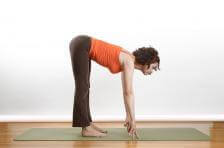
I actually do my hip hinges while I’m taking a cold shower to maximize the fat-burning effect.
Simply cross both hands across your chest, then hinge forward at the hips while looking forward and keeping your back straight. You’ll reach a point at which your hamstrings feel very tight and you can’t hinge forward anymore without bending your back. Once you reach that point, “squeeze” your butt cheeks and use your butt to pull you back into your starting standing position. This exercise is also known as the folded dollar bill or the shadow deadlift exercise. Here's a great video that contains a ton of similar exercises that are fantastic for your lower back and your glute muscles.
If you have questions about these 5 new fat burning exercises, or your own exercises to add to the list, post your comments below or at Facebook.com/GetFitGuy
As you learned in the episode 10 Flat Stomach Alternatives to Crunches, I’m not a huge fan of crunches. Not only do crunches burn a miniscule amount of calories and fat, but because they involve lying on your back and repeatedly bending and extending at the spine, they’re a big culprit when it comes to placing excessive strain directly on the portion of the low back that has the most nerves and is most susceptible to injury and fatigue..
So how can you maintain six-pack abs without doing crunches? One of the keys is a hidden ab muscle that you tend to hear very little about. In today’s episode, you’re going to learn exactly what that ab muscle is.
The Hidden Ab Muscle That Will Get You a Six-Pack
There is a muscle called the Transverse Abdominus that acts as a stabilizer to the middle part of your body. This muscle is actually located right behind your abdominal muscles. If you’re not familiar with this muscle, you may want to sign up for the military, because military drill sergeants are very aware of how to make the Transverse Abdominus sore. The reason drill sergeants love exercises that involve the Transverse Abdominus is because when this muscle is strong, your back and stomach are strong. And if you want a strong stable core that helps six-pack abs form, this muscle must be strong.
As a matter of fact, I spoke with one of my military friends, seargant Michael Volkin, and he had this to say about the Transverse Abdominis:
“I have to admit, I was doing sit ups for most of my adult life, but when I reached 30 I realized that my ab muscles were getting harder to see. No matter what I ate (or didn’t eat) and no matter how many stomach exercises I did, my abdominal muscles kept slowly disappearing. Then, I did some research on the anatomy of the stomach muscles and found the Transverse Abdominus. Ever since then, I am happy to say my stomach muscles are more prevalent than ever before. Not only that, my posture is better.”
So why did Michael find that this rarely mentioned ab muscle makes such a big difference? It’s primarily because the Transverse Abdominus is connected to your back, your ribs, and your pelvis. In essence, it is the ultimate stabilizing muscle for your entire mid-section.
However, there is a catch: This can be an extremely difficult muscle to strengthen, and although there are a multitude of techniques and exercises for strengthening the abs, few of them target the Transverse Abdominus. But here are three exercises that actually do target this hidden ab muscle in a way that will get you a six-pack: Exercise #1: The Focused Crunch – This exercise is far different than a traditional abdominal crunch and involves what is called an isometric hold. .
Lay on the floor with your knees bent and your feet firmly on the floor.
Put your hands just below and to the sides of your belly button. Press a couple fingers from both hands into your lower abdomen.
Begin by drawing your lower abdomen down towards the floor, but do not move your pelvis. Your chest should rise slightly.
Stop drawing in your stomach as soon as you feel your muscles begin to tighten. The muscles underneath your fingers should feel tight. If you move too far, you will stop working your Transverse Abdominus and instead begin stressing your oblique muscles.
Hold this position for 10 to 15 seconds while breathing normally.
Begin with 10-12 repetitions, and be cautious not to overdo it the first time you do these - or the next day you will be very sore.
When combined with proper nutrition, these three exercises will target your hidden ab muscle and get you a firm, defined six-pack. If you have more questions about targeting your Tranverse Abdominus, then join the conversation over at the Get-Fit Guy Facebook page!Want more push-up variations that will target the Transverse Abdominus in a similar way? Check out the Get-Fit Guy episode Top 16 Push-Up Variations.
Start in the push-up position with your palms on the floor and toes on the ground. Your back should be straight and your feet should be hip-width apart.
Raise one leg as high as you can and then do a push-up. Switch legs and repeat.
Start with three sets of 10-12 repetitions, and increase repetitions as needed.
Exercise #3: Modified Plank Pushup - This is a tough exercise, so proceed with caution.
Lay on the floor with your knees bent and your feet firmly on the floor.
Place your hands under your buttocks and raise your head off the ground. If your head is not raised, the exercise loses its effectiveness.
Raise one leg about 12 inches off the ground and slowly lower it back down.
As you lower one leg, raise the other in the same manner.




 You can do a number of exercises with Tabata training – including


 I actually do my hip hinges while I’m